
 Project Will Revive the Creek’s Headwaters and Improve Water Quality, Habitat, and Flood Resilience
Once a free-flowing waterway, McCoys Creek has long suffered from pollution, overgrowth, flooding, and decades of disruption from industrial activity and urban development. But thanks to a strong public‑private partnership between the City of Jacksonville (COJ) and Groundwork Jacksonville (GWJax), the creek’s transformation is taking another leap forward.
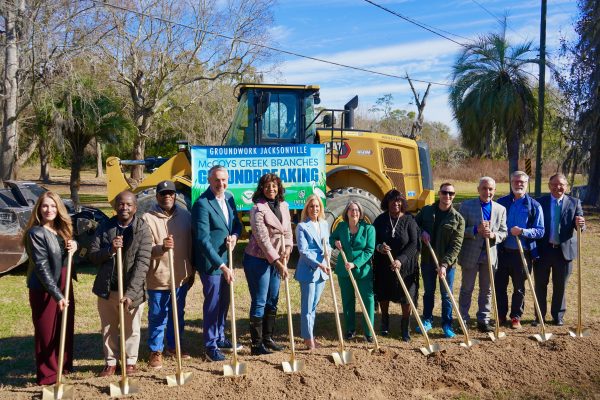
On Wednesday, February 4, GWJax, the COJ, and community representatives—including residents of North Riverside—gathered at Hollybrook Park to break ground on the McCoys Creek Branches restoration project. The initiative marks a critical milestone in returning the western headwaters of McCoys Creek to a cleaner, healthier, and more natural state while supporting the broader vision of the McCoys Creek restoration and the Emerald Trail.
“Breaking ground on the McCoys Creek Branches is more than a construction milestone—it represents the beginning of a healthier, more resilient future for this community,” said Kay Ehas, CEO of GWJax. “Restoring the headwaters is essential to healing the entire creek system, improving water quality, reducing flooding, and creating access to nature for generations to come. This is what environmental equity looks like in action, and we’re proud to lead this effort and work hand‑in‑hand with the City and our neighborhood partners to bring it to life.”
The Branches project will eliminate polluted and eroding ditches, remediate contaminated soils from a former ash‑dumping site, and create accessible, restored natural areas within the neighborhood. In total, the work will restore 4,752 linear feet of the McCoys Creek headwaters, including 14.93 acres of stream and wetlands and 3.9 acres of open space for future recreation. More than 10,000 trees will be planted in addition to tens of thousands of native plants.
The project area drains a 3.74‑square‑mile watershed into the creek’s main stem. Restored headwaters will slow flows, reduce flood peaks, and significantly improve water quality downstream. The design includes a natural meander within a newly vegetated wetland floodplain, increasing habitat diversity, water storage capacity, and ecological resilience.
Groundwork Jacksonville received a grant from the Jacksonville Environmental Protection Board to study potential nutrient reduction. It is estimated that the Branches project will remove 3,600 pounds of nitrogen and 570 pounds of phosphorus from the creek each year. The restoration will create habitat for fish, forage species, benthic macroinvertebrates, and a wide range of native birds through the establishment of freshwater forested wetlands, herbaceous wetlands, riparian buffers, and stream enhancements.
 Modeling shows the McCoys Creek restoration benefits homes too. Within the branches area, 20 residential structures are currently at risk during a 100‑year storm. When all phases are complete, the creek restoration project will remove 18 of the structures from flood risk and the remaining two will experience less than one foot of flood risk.
WSP is the design engineering firm for the McCoys Creek project. According to Rebecca Vanderbeck, PE, Vice President North Florida Local Business Lead, “This project is a rare opportunity to improve water quality, restore vital habitat and reconnect our neighborhoods to nature. Together, we’re redefining what resilience looks like and proving what’s possible when we share a common vision for our community’s future.”
Mayor Donna Deegan said, “This project reflects what is possible when government, nonprofits, and residents work together toward a shared vision. For decades, neighbors here have lived with the impacts of pollution, flooding, and disinvestment. Today marks the beginning of repair—not just of the creek, but of the relationship between people and the natural environment that surrounds them. We’re honored to partner with Groundwork Jacksonville to return McCoys Creek to the community as a beautiful asset along the Emerald Trail.”
Construction of the Branches begins this month at a projected cost of $12.65 million. Kiewit is the construction contractor and C&ES is the construction engineering inspection firm. The project is being funded through a $5.18 million Resilient Florida program grant from the Florida Department of Environmental Protection, awarded to the COJ in collaboration with GWJax.
Funding is also supported by a $2.6 million grant to GWJax from the NOAA Fisheries Office of Habitat Conservation’s Community-based Restoration Program, which provides funding to local partners to restore habitat in support of fisheries, communities, and ecosystems. Restoring flow to McCoys Creek will help protect residential areas from flooding while re-establishing a connection between critical habitats for fish like red drum and flounder.
The COJ will fund the remaining project cost in addition to contamination remediation. Project design was developed by WSP in collaboration with SCAPE Landscape Architecture and funded by GWJax through a National Fish and Wildlife Foundation (NFWF) grant and private donors.
